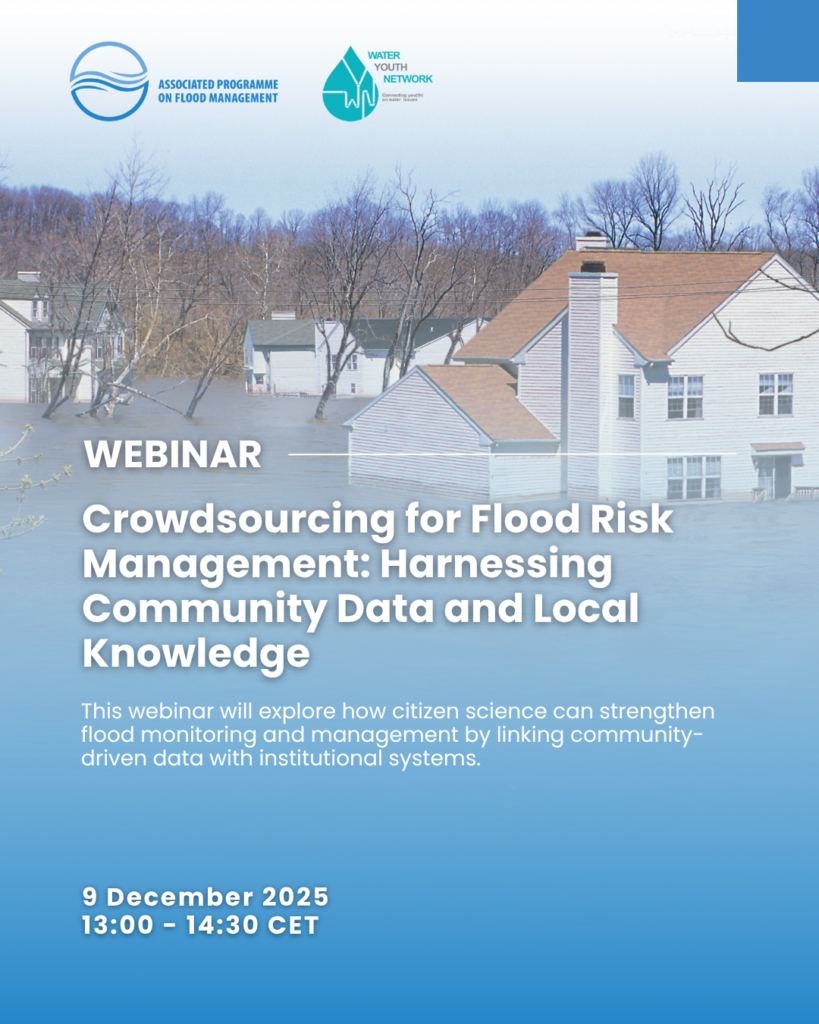
9 December 2025 – 13:00 – 14:30 CET
Effective flood risk management depends on timely and accurate information on rainfall, river levels, inundation areas, and impacts. Yet in many countries, especially in data-scarce regions, observation networks remain sparse and early warning systems often fail to capture community-level realities. This results in significant gaps between forecasts and the actual risks faced by households and local institutions.
Crowd-sourcing/citizen science can help address the issue: the systematic collection of data by volunteers using simple tools such as smartphones, SMS reporting, social media, drones, or participatory mapping, offers an innovative, low-cost way to bridge this gap. Integrating such approaches into national and basin-level systems also supports the Early Warnings for All (EW4All) initiative, which emphasises people-centred early warning systems and community ownership of disaster risk reduction.
Objectives of the Webinar
The purpose of this webinar was to explore how crowdsourcing can strengthen flood monitoring and management by linking community-driven data with institutional systems.
Specific objectives of the webinar were:
-
-
To showcase practical examples of crowdsourced flood data collection and its contribution to early warning and response.
-
To reflect on the challenges and opportunities of integrating citizen-generated data into formal flood management frameworks.
-
To identify pathways for APFM partners to scale up crowdsourcing approaches in support of EW4All and community resilience.
-
The following projects were presented at the webinar :
| Collaborative Mapping for Flooding Resilience in Medellin, Colombia | Yessica De Los Rios Olarte, Youth Leader |
| Participatory flood mapping in the Volta Basin, Malawi and Costa Rica | Gabriele Quinti, Knowledge & Innovation |
| Integrated crowdsourced flood risk knowledge | Martijn Kwant, Deltares |
| CrowdWater | Jan Seibert, University of Zurich |
Webinar Material
The presentations showcased at the webinar are available here.
The Webinar recording is available here.